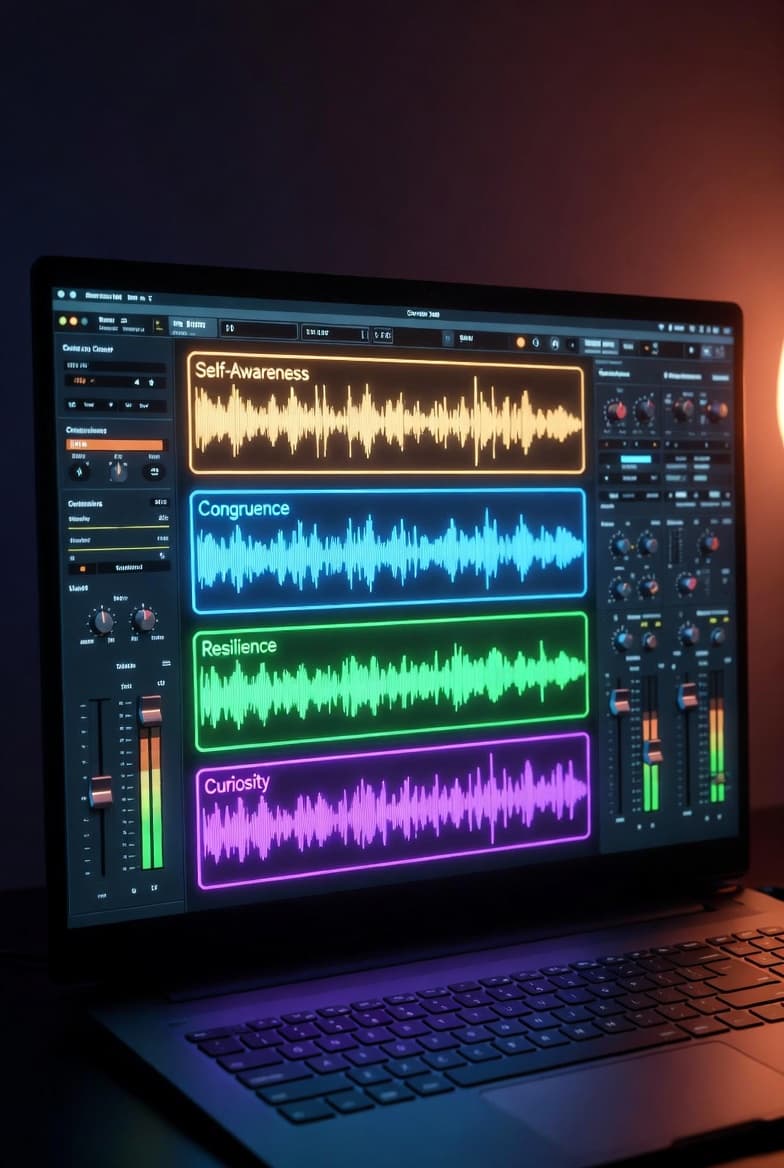
Stems: The 4 Pillars
Howdy, and welcome to Chapter 1.
Before we get into the fancy stuff — the compression, the automation, the eq curves — we need to talk about stems. Because if your stems are garbage, your final mix will be garbage. No amount of mastering will save you.
In audio production, stems are the isolated, individual tracks that make up a song. The drums on one track. Bass on another. Vocals separate. Synths over here. Each stem is clean, distinct, and purposeful. When you solo a stem, you hear exactly what it's contributing to the mix.
Your social presence works the same way.
The Four Stems
After years of watching developers struggle (including the one I see in the mirror), I've identified four foundational stems that everything else builds on:
- Self-Awareness — knowing what you're actually putting out
- Congruence — making sure your tracks aren't fighting each other
- Resilience — keeping the signal clean when the session gets rough
- Curiosity — the stem that makes everything else interesting
Let me break each one down.
Before we do, one important note: these stems are multiplicative, not additive.
If one stem is weak, it drags the others down:
- High curiosity + low self-awareness can come off as intrusive
- High resilience + low congruence can look fake or performative
- High congruence + low curiosity can feel rigid and self-focused
The goal isn't perfection in one area. The goal is a balanced mix that holds up in real conversations.
Stem 1: Self-Awareness
Here's a fun experiment. Record yourself on a Zoom call without telling yourself you're being recorded (use your meeting software's auto-record feature). Then watch it back.
I'll wait.
Horrifying, right? That's what everyone else sees. The face you make when you're thinking. The way you interrupt. The nervous laugh that shows up every 45 seconds. The dead-eye stare when someone else is talking.
Self-awareness is the ability to hear your own track clearly.
Most developers have terrible self-awareness in social situations because they're too busy processing the content to monitor the delivery. They're thinking about what to say next, not how they're being perceived right now.
I used to nod aggressively when people talked, thinking it showed engagement. Turned out it made me look like a bobblehead having a seizure. Nobody told me for years. When I finally watched myself on video, I was mortified.
How to Build This Stem
The Playback Exercise: Once a week, watch a recording of yourself in a meeting or conversation. Don't judge yourself — just observe. Notice:
- Your facial expressions when others speak
- How often you speak vs. listen
- Physical habits (fidgeting, posture, eye contact)
- Your tone of voice throughout
The Mirror Check: Before important conversations, literally look in a mirror and practice your opening line. Watch your face. Does your expression match what you're trying to convey?
The Trusted Reviewer: Find one person who will give you honest feedback on your social presence. Not "you're fine," but actual notes. This is your mix engineer.
Stem 2: Congruence
Ever listened to a track where the vocals say one thing but the music says another? It's jarring. The lyrics are about heartbreak but the beat sounds like a party anthem. Something feels off even if you can't articulate why.
Congruence is when all your tracks are telling the same story.
Your words, tone, body language, facial expressions, and actions should all be playing the same song. When they're not, people feel it. They might not be able to name it, but they'll walk away feeling like something was... off.
I had a manager once who would say "I'm really excited about this project" while sighing and looking at the floor. His words said yes but everything else said no. We never trusted him. Not because he was lying, but because his tracks were fighting each other.
Common congruence problems in developers:
- Saying "I'm happy to help" while your body language screams "leave me alone"
- Claiming you're open to feedback while defensively crossing your arms
- Asserting confidence while your voice goes up at the end like everything's a question?
- Promising you're fine when your face could stop a clock
How to Build This Stem
The Alignment Check: Before important conversations, ask yourself: What do I actually feel about this? Then make sure your delivery matches. If you're frustrated, it's better to acknowledge "I'm frustrated about this" than to pretend you're fine while leaking irritation everywhere.
The Three-Channel Monitor: In any conversation, periodically check three channels:
- What are my words saying?
- What is my tone saying?
- What is my body saying?
If any two of these disagree, people will believe the one you're not consciously controlling.
The Authenticity Edit: Stop using phrases you don't mean. If you're not "super excited," just say you're interested. If you don't "love" the idea, say it has potential. Smaller, honest claims are more congruent than inflated ones.
Stem 3: Resilience
Sessions go wrong. Computers crash. Plugins fail. Collaborators flake. A producer who can't handle adversity doesn't finish albums.
Resilience is the ability to maintain signal quality when the session gets rough.
Social situations will go sideways. You'll say the wrong thing. Someone will misunderstand you. You'll get negative feedback. You'll bomb a presentation. You'll have a conflict with a coworker. The question isn't whether these things will happen — it's whether you can recover without your whole mix falling apart.
I once completely blanked during a presentation to VP-level executives. Like, mid-sentence, gone. The room was silent. My internal monologue was screaming. But instead of melting down, I took a breath and said, "Well, that thought just completely left the building. Let me check my notes."
People laughed. Not at me — with me. The resilience to acknowledge the failure without crumbling actually built more trust than a flawless delivery would have.
How to Build This Stem
The Failure Reframe: After every social fumble, ask yourself: "What's the smallest lesson I can extract from this?" Not a deep therapy session — just one small, actionable note for next time.
The Recovery Phrases: Prepare three phrases you can use when things go wrong:
- "Let me try that again."
- "That came out wrong. What I meant was..."
- "I'm drawing a blank — give me a second."
Practice them out loud so they're available when you need them.
The Post-Game Limit: Give yourself a 24-hour maximum to dwell on social failures. After that, the tape is erased. You're not allowed to replay it anymore. (This one takes practice. I still struggle with it.)
Stem 4: Curiosity
Here's the weird thing about social skills: the more you focus on yourself, the worse you get. The most magnetic people in any room are the ones who are genuinely curious about others.
Curiosity is the stem that makes everything else interesting.
When you're curious about someone, you ask better questions. You listen more carefully. You remember details. You make them feel valued. All of this happens naturally, without you having to fake "engagement."
I used to prepare talking points before networking events. Then I realized the people I actually enjoyed talking to never seemed to have prepared talking points. They just asked me questions and seemed genuinely interested in the answers.
The secret? Curiosity isn't a technique — it's a decision. You decide to be interested in the person in front of you. You choose to believe they know something you don't. You assume they have a story worth hearing.
How to Build This Stem
The Three Question Rule: In any conversation, ask at least three follow-up questions before talking about yourself. Not interrogation-style — natural follow-ups that dig deeper.
The Assumption of Expertise: Assume every person you meet is an expert in something you know nothing about. Your job is to find out what that thing is.
The Context Safari: When you meet someone, imagine you're a documentary filmmaker trying to understand their world. What makes their day-to-day different from yours? What problems do they solve that you've never considered?
The Mix Session
This week, I want you to focus on recording clean stems. Here are your exercises:
Exercise 1: The Self-Awareness Audit
Record yourself in at least one meeting this week. Watch it back. Take notes on three things you do well and three things you want to change. No judgment — just data.
Exercise 2: The Congruence Check
Pick one important conversation and do the Three-Channel Monitor in real-time. Afterward, write down whether your words, tone, and body were aligned. If not, what was the disconnect?
Exercise 3: The Resilience Prep
Write down three recovery phrases that feel natural to you. Practice saying them out loud until they're automatic.
Exercise 4: The Curiosity Challenge
In at least two conversations this week, ask three follow-up questions before sharing anything about yourself. Notice how it changes the dynamic.
Exercise 5: Stem Gap Analysis
Rate each stem from 1-10 based on your behavior this week:
- Self-Awareness
- Congruence
- Resilience
- Curiosity
Pick the lowest score and choose one tiny behavior to improve next week. Example: "Pause one second before responding in meetings" or "Use one recovery phrase when I stumble."
Don't chase all four at once. Fix the biggest bottleneck first.
Track Notes
- Stems are foundational. If these four tracks aren't clean, nothing else will sound right.
- Self-awareness means hearing your own track clearly — use recordings and feedback.
- Congruence means all your channels are playing the same song — words, tone, and body aligned.
- Resilience means maintaining signal when things go wrong — have recovery phrases ready.
- Curiosity means focusing on others — it's not a technique, it's a decision.
Record these stems clean. Solo them. Make sure they sound right on their own before we start mixing.
Next chapter, we'll work on your signature sound — the personal brand that makes people recognize you instantly.
Studio Notes
Studio Note: In audio production, stems are the isolated, individual tracks that make up a finished song — drums on one track, bass on another, vocals on a third, and so on. Think of it like a layered Photoshop file: each layer is independent, but they combine into the final image. When a producer solos a stem, they listen to just that one track by itself to make sure it sounds clean before blending it back in.